


Farkle Dice Game: Online 10000
AppForge Interactive Entertainment FZ-LLC
Farkle Dice Game: Online 10000 is the kind of board game I open when I want a quick contest that still gives me meaningful decisions. It uses the familiar Farkle dice format, but places the experience on a phone, where I can play with friends, enter online multiplayer matches, or take part in tournaments. The basic appeal is easy to understand: roll, choose scoring dice, decide whether to stop or risk another throw, and try to finish ahead of the table.
That simplicity makes it approachable, but it does not make every choice obvious. A safe score can be better than a greedy attempt, especially when another player is already close to the lead. I found that the game becomes more enjoyable once I stopped treating every roll as a chance to chase the biggest possible number. It rewards reading the situation, not just hoping for lucky dice.
What the first game feels like
The first thing to expect is a compact digital version of a classic dice board game rather than a long strategy campaign. The store summary focuses on playing with friends, online multiplayer matches, and tournaments, so the strongest reason to install it is the social competition. I would not choose it if I wanted a story, a collection of elaborate boards, or a heavily guided solo adventure. I would choose it for short sessions where the tension comes from deciding whether one more roll is worth the danger.
The rules are built around a push-your-luck rhythm. I make a roll, set aside useful scoring dice, and then choose between banking the points or continuing. Continuing can improve a turn dramatically, but a bad roll can remove the progress I was trying to protect. That tension is the heart of the game, and it remains interesting because the correct decision changes with the score, the opponents, and the stage of the match.
For a first-time player, the most important mindset is to separate available points from points that are already safe. A promising roll is not automatically a good reason to continue. If I have built a respectable lead, protecting it may be smarter than chasing a spectacular turn. If I am behind late in a match, the calculation changes, and a risk that would normally look careless can become reasonable.
Related News

Threads in Real Life: Who Should Join, Lurk, or Leave

How SHEIN Turned Shopping Into an Endless Content Feed

How to Make Fortnite Feel Smarter on Mobile

Should You Switch to Microsoft Outlook on Mobile?

Why Gallery Keeps Pulling Users Back

X Review: Why Its Network Still Matters
The game is free to download, which makes trying a few rounds easy. It is rated for Everyone, so it is suitable for a broad audience from a content perspective. Optional in-app purchases range from $0.99 to $99.99 per item, so I would still recommend checking the purchase flow carefully if a child will be using the device. The free entry point is useful, but “free” does not mean every optional item or shortcut is automatically cost-free.
Why the format works well on a phone
Dice games benefit from short turns, and this one fits naturally into spare moments. I can imagine playing during a coffee break, waiting for an appointment, or sharing a few rounds with someone who is not in the same room. The online focus also gives the familiar rules more energy than rolling alone against an inactive score sheet.
At the same time, online play changes the ideal session length. A quick local dice game can be abandoned without much consequence, while a multiplayer match deserves enough attention to finish properly. I would avoid starting one when I know I may need to put the phone away immediately. The game is casual in its rules, but other players still depend on everyone taking their turns.
Gallery
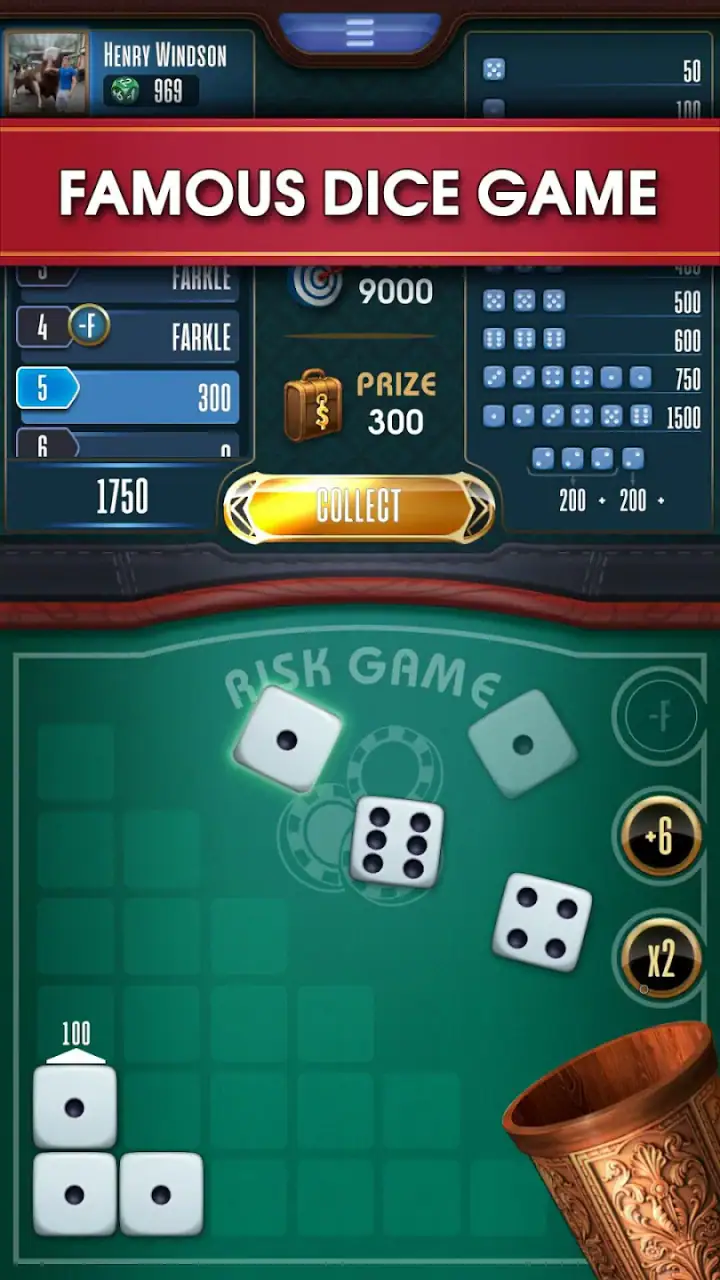
Its audience is fairly clear. It is a good fit for people who already enjoy Farkle, Yahtzee-style risk decisions, or board games where luck and judgment share the spotlight. It is also a friendly entry point for someone who has never played the physical version, because the dice provide immediate feedback and the main decision repeats naturally. Players who dislike randomness, competitive waiting, or making choices with incomplete control may find the experience frustrating rather than relaxing.
Getting ready without overthinking the setup
The game comes from AppForge Interactive Entertainment FZ-LLC and supports devices running Android version 6.0 or later. That makes it accessible to many older Android phones, although the smoothness of any online game can still depend on the individual device and connection. I would install it, open it, and spend a little time understanding the first available screen before worrying about tournaments or competitive results.
My recommended first setup is deliberately simple. Keep the opening session focused on learning the turn cycle: roll, identify scoring dice, bank or continue, and watch how the total changes. Do not begin by trying to optimize every decision. The useful information comes from seeing what the interface considers part of the current scoring combination and how the game handles the end of a turn.
One practical habit helps immediately: pause for a second after every roll. New players often tap quickly because the dice animation creates momentum, then continue without considering the value already on the table. I found it better to read the score area first, identify which dice are being used, and only then decide. That small pause prevents many avoidable mistakes.
It is also worth distinguishing between a match with friends and a broader online contest. Playing with people I know creates a more relaxed learning environment because I can discuss the rules and laugh off a risky turn. A competitive match is better once I understand the scoring flow. Entering a tournament before I am comfortable with the basic choices can make the game feel more confusing than it really is.
The first meaningful success
My definition of a successful first session would not be winning a tournament. It would be completing a turn in which I deliberately choose a stopping point instead of continuing automatically. That is the first decision that makes the game feel like a game rather than a dice animation. Once I can explain to myself why I banked the score, I am beginning to understand the central trade-off.
A useful beginner workflow looks like this:
After the roll, identify every scoring option the screen presents and note the value that can be secured immediately.
Ask whether the current total would be helpful if the turn ended now, rather than imagining only the best possible next roll.
Continue only when the potential improvement is worth the possibility of losing the turn’s progress.
If the next roll produces a strong result, reconsider the whole situation instead of following the original plan automatically.
This process is more useful than memorizing a single “always stop at this number” rule. The right threshold depends on whether I am leading, chasing, or trying to recover from a poor opening. It also depends on how much of the match remains. A conservative decision early on may be sensible, while the same decision near the end may leave too much work for later.
One non-obvious lesson is that a modest successful turn can have strategic value beyond its visible score. Banking points can force opponents to take more risks if they need to catch up. In that sense, stopping is not passive. It can change the pressure on everyone else at the table.
Another useful lesson is to treat a lucky sequence as an opportunity, not a promise. When several rolls go well, it is tempting to believe the pattern will continue. The dice do not owe me a favorable next result. I enjoy the excitement of a long turn, but I try to decide at each stage as if the next roll could immediately end the run.
Where new players commonly get confused
The biggest source of confusion is usually not the dice themselves but the relationship between a turn score and the overall match score. A number that looks impressive in the moment may not be enough to change the standings, while a smaller number may be valuable if it protects a lead. I recommend checking the table after each turn so that the decision is connected to the actual competition.
Players can also misunderstand the purpose of continuing. Continuing is not simply “playing for more.” It is accepting a specific risk in exchange for a possible improvement. If I cannot describe what I am trying to gain from the next roll, I am probably continuing out of excitement rather than judgment.
The online setting adds another layer. A delayed turn may feel like a frozen game, but it can also reflect the other player taking time to decide. I try not to tap repeatedly or assume something has gone wrong immediately. Patience matters more in a multiplayer game than it does in a private practice round, particularly when the match involves people with different connection conditions.
Tournaments can be confusing for a different reason: they make each result feel more important. That pressure can push a new player toward unnecessarily dramatic choices. I would use the first tournament entries as observation opportunities. Notice how experienced players manage leads, when they stop, and how often they accept a safe result. The aim is to learn the pace of competitive play rather than to measure personal ability by one unlucky match.
There is also a social question: is this mainly a game for playing with friends, or can someone enjoy it without an existing group? The answer depends on what I want from it. The online multiplayer and tournament focus give it value beyond a private friend circle, but the most personal and relaxed experience comes from inviting people I already know. Someone looking for a purely offline pastime should choose a different dice app or a physical set instead.
Small decisions that improve the experience
I would begin by playing several turns with one goal at a time. In one session, focus on recognizing scoring combinations. In another, focus on stopping at sensible moments. This is better than trying to master scoring, opponent reading, tournament pressure, and risk management all at once.
A second tip is to watch the leader rather than only watching my own total. The standings tell me whether I need to preserve a margin or create one. If I am comfortably ahead, a safe turn may be the strongest move available. If I am far behind, I may need to accept a higher chance of losing a turn. The same dice result can therefore deserve different treatment in two different matches.
A third tip concerns session timing. Because the game is designed around matches rather than a single instant roll, I would start a competitive round only when I have enough uninterrupted time to pay attention. For a very short break, reviewing rules or playing a brief casual round is more sensible than committing to a match I might leave unfinished.
A fourth trade-off involves purchases. Since the game is free to start but includes optional items priced from $0.99 to $99.99, I would decide in advance whether I am willing to spend anything. That boundary keeps the focus on decision-making rather than turning a close result into a reason to buy something impulsively. For many players, the free starting experience will be enough to determine whether the core dice loop is enjoyable.
The current version is 2.14.1.27, and the game has been available since March 27, 2020. Those details matter mainly because they place the app in an established, ongoing product rather than a brand-new experiment. I would still judge it by how well the present version fits my device and playing habits, not by its age alone.
How it compares with familiar alternatives
Compared with a physical Farkle set, the app removes the need to find dice, track scores on paper, and coordinate a table in the same room. That convenience is its clearest advantage. Online play also makes distance less of a barrier. The physical alternative remains better for a family gathering where conversation, shared objects, and face-to-face reactions are the main point.
Compared with a simple offline dice app, this game is more appealing if I want opponents, multiplayer matches, and tournaments. The trade-off is that online competition asks for a connection and a little more commitment. An offline alternative is preferable for travel, unreliable service, or a player who wants complete control over the pace.
Compared with other board games on mobile, Farkle Dice Game: Online 10000 is easier to learn than a title with a large deck of rules or a long campaign. Its depth comes from risk management, not from dozens of systems. That makes it a strong casual choice, but a weaker one for anyone seeking character progression, elaborate customization, or a sense of exploration.
The rating of 4.3 from around 9.8 thousand ratings suggests that many players find the overall experience worthwhile, while the broader review count of about 2.3 thousand shows that people have taken time to discuss it. I treat those numbers as a useful signal, not a substitute for personal fit. A player who loves quick competitive dice decisions may enjoy it immediately; someone who wants predictable outcomes may not.
Who should install it, and who should skip it
I would recommend it to a friend who enjoys the emotional swing between a safe score and a tempting extra roll. It works especially well for casual groups that want a shared game without arranging a physical table. It is also a sensible introduction to Farkle for someone who wants to learn by playing rather than reading a long rulebook.
I would hesitate to recommend it to a person who dislikes luck as a major part of a board game. Good decisions improve the chances of success, but they cannot remove uncertainty from the dice. I would also point elsewhere for someone who needs an entirely offline experience, wants a single-player campaign, or finds turn-based online competition too slow.
Parents and younger players should find the Everyone content rating reassuring, but I would still pay attention to the optional purchase range and the social nature of online matches. The age label describes content suitability; it does not replace normal guidance about spending and online interaction.
The next step after learning the basics
Once the turn cycle feels natural, I would move from casual practice to deliberate multiplayer play. Before each turn, make one clear assessment: am I protecting a lead, building a challenge, or recovering from a bad position? That question keeps the game grounded when the dice become exciting.
After that, tournaments become more interesting because I can evaluate decisions rather than simply react to results. A lost match may still contain a good choice, and a win may include a risky decision that happened to work. Reviewing those moments is where the game offers more depth than its simple rules suggest.
My overall view is positive, with a clear qualification. Farkle Dice Game: Online 10000 is not trying to replace every kind of board game. Its strength is the focused push-your-luck loop, made more convenient by online play and tournaments. Its weaknesses are the same qualities that define it: randomness, dependence on an online setting, and the possibility that a short game can become surprisingly tense.
With over 500 thousand installs, it has reached a substantial audience, but popularity is not the main reason I would suggest it. I recommend it because the first meaningful decision arrives quickly, the rules are approachable, and careful stopping can matter as much as a lucky roll. If that balance sounds appealing, the free download is an easy way to find out whether this particular dice battle belongs in your regular game rotation.
FAQs for Farkle Dice Game: Online 10000
What is Farkle Dice Game: Online 10000, and how is it played?
Farkle Dice Game: Online 10000 is a dice-based game built around the classic goal of reaching 10,000 points before your opponents. You roll a set of dice, keep scoring combinations, and decide whether to continue rolling or bank your points. The risk is that an unsuccessful roll can erase the points collected during that turn, so good timing and strategy are essential.
Can I play Farkle Dice Game: Online 10000 offline or without creating an account?
The availability of offline play and account-free access can depend on the version installed and the developer’s current settings. In general, players may find solo or computer-based modes more suitable when they do not have an internet connection, while online multiplayer normally requires connectivity. Check the app’s permissions, login screen, and store description before downloading if offline access is important to you.
Does the game support online multiplayer with friends or other players?
Online multiplayer is one of the main attractions of Farkle Dice Game: Online 10000, allowing you to compete in dice matches beyond a local solo experience. Depending on the current version, you may be matched with other players or invited to games through available social features. A stable connection is recommended because interrupted matches, delays, or reconnection issues can affect the experience.
Is Farkle Dice Game: Online 10000 free to download, and does it contain ads or in-app purchases?
The game can generally be downloaded without an upfront purchase, but free access may be supported by advertising, optional purchases, or both. Ads may appear between rounds or during menu navigation, while purchases can sometimes provide cosmetic items, bonuses, or an ad-free experience. Review the Google Play or App Store listing and your device’s purchase settings before allowing transactions.
What should new players know about the scoring and strategy?
New players should learn the scoring combinations before taking unnecessary risks. After every successful roll, you must choose whether to secure your current points or roll again for a larger total. Rolling more dice can create exciting opportunities, but it also increases the chance of a Farkle and losing the turn’s accumulated score. Conservative decisions are often just as valuable as lucky rolls.
Pros
- Simple rules make it easy for beginners to start playing.
- Online matches add variety beyond playing against the computer.
- Quick rounds fit well into short breaks or casual sessions.
- Dice rolls and scoring create a satisfying mix of luck and strategy.
- The game provides a familiar take on classic Farkle gameplay.
Cons
- Luck can strongly influence results
- even when decisions are sensible.
- Online play may be less enjoyable with an unstable internet connection.
- Frequent ads can interrupt the flow of some game sessions.
- Players seeking deep strategy may find the mechanics fairly limited.
- Matchmaking quality may vary depending on the number of active players.


